

Chinese lacquerware is one of the oldest continuous art forms in human civilization, a craft born from the sap of the lacquer tree (Toxicodendron vernicifluum) that has adorned the homes, temples, and tombs of China for over seven millennia. Unlike painted finishes that merely sit on a surface, true lacquer creates a chemical transformation: when the raw sap is exposed to humidity-controlled air, it polymerizes into a hard, glass-like coating that is resistant to water, acid, heat, and even time itself. The result is not merely decorative but functional—a protective skin that can preserve wooden objects for thousands of years, as evidenced by lacquerware recovered from Neolithic burial sites still bearing their original luster. This guide traces the full arc of Chinese lacquer art, from its misty origins along the Yangtze River to the virtuoso masterpieces of the Ming and Qing courts, and explains what makes this demanding craft one of the most revered in the world’s decorative arts.
The Essence of Lacquer: What It Is and How It Works
Raw lacquer is harvested much like maple syrup: the bark of the lacquer tree is scored diagonally, and the milky-gray sap is collected drop by drop. A mature tree yields only a few hundred grams per season, which partly explains the material’s inherent value. The sap contains urushiol—the same compound that causes poison ivy reactions—along with laccase enzymes that trigger polymerization when exposed to warm, humid air (ideally 25–30°C with 75–85% humidity). This curing process is entirely chemical, not evaporative: lacquer “dries” by hardening, not by losing water, which gives it its exceptional durability.
The harvested sap is refined through filtration, heating, and pigment blending. Iron oxide yields black; cinnabar (mercury sulfide) produces the iconic vermilion red; orpiment gives yellow; and indigo or azurite creates blue. Each pigment interacts with the urushiol differently, which is why red and black dominated historical lacquer: these were the most chemically stable colors in the traditional palette.
Unlike modern synthetic coatings, urushi lacquer continues to harden and become more resistant over decades. Archaeological lacquerware from the Warring States period (475–221 BCE) has been excavated with its gloss intact, the lacquer having cross-linked into a molecular structure that rivals modern epoxy in hardness.
7,000 Years of History: From Neolithic Beginnings to Imperial Mastery
Neolithic Origins (c. 5000 BCE)
The earliest known lacquer object—a red-lacquered wooden bowl—was discovered at the Hemudu culture site in Zhejiang Province, dating to approximately 5,000–4,000 BCE. This find pushes the birth of Chinese lacquer back to the dawn of settled agriculture in the Yangtze River basin, where the lacquer tree grew wild. These Neolithic pieces are rudimentary by later standards: the lacquer is applied directly to carved wood with little surface preparation, and only red and black pigments appear. Yet the technical foundation—understanding that lacquer sap could be refined, colored, and cured into a protective coating—was already established.
Shang and Zhou Dynasties (c. 1600–256 BCE)
By the Shang dynasty, lacquer was being used to coat chariot fittings, weapon handles, and ritual vessels. Excavations at the Anyang site reveal lacquer applied over textile-wrapped cores, a technique called xiazhu that would later blossom into the sophisticated “bodiless” lacquer of later dynasties. The Zhou dynasty saw lacquer production expand dramatically: the Kaogong Ji (Artificers’ Record), a Zhou technical manual, mentions lacquer as a regulated material under state control. Lacquered objects from this period include not only practical items but the earliest known lacquer musical instruments, including zithers and drums.
Warring States, Qin, and Han (475 BCE–220 CE)
This golden age of early lacquer produced pieces of breathtaking sophistication. The Shu (Sichuan) region became a major production center, and the lacquer trade flourished along the Yangtze. Warring States tombs at Changsha and Jingmen have yielded lacquer ear cups, cosmetic boxes, and figurines painted with extraordinary precision—phoenixes, dragons, and cloud scrolls in red and black, the color scheme that defined Chinese lacquer for millennia.
The Han dynasty institutionalized lacquer production on an industrial scale. Imperial workshops in Shu Commandery (modern Chengdu) and Guanghan employed thousands of artisans, each piece marked with the names of individual craftsmen and supervisors—an early quality-control system. The Mawangdui tombs (168 BCE) contained over 300 lacquer pieces in pristine condition, including nested cosmetic cases, wine vessels, and a lacquer coffin painted with celestial scenes. Han artisans also developed the pingtuo technique, inlaying gold and silver foil into lacquer surfaces, a direct precursor to later inlay masterpieces.
Six Dynasties, Sui, and Tang (220–907 CE)
Buddhism’s arrival in China transformed lacquer art. Lacquer was used for gilded Buddhist sculptures through the dry-lacquer (tuo tai) technique: a clay core was layered with lacquer-soaked hemp cloth, the clay was removed after curing, and the resulting hollow, lightweight form was gilded. This method allowed the creation of monumental yet transportable statues. Tang dynasty lacquer also saw the maturation of gold and silver inlay, mother-of-pearl (luodian) work, and the earliest examples of carved lacquer. The Tang court maintained dedicated lacquer workshops, and Chinese lacquer began to influence Korean and Japanese craftsmen who traveled to study on the continent.
Song and Yuan (960–1368 CE)
The Song dynasty prized restraint and refinement over ostentation. Lacquerware from this period tends toward monochrome elegance—single-color black or red pieces with clean silhouettes and minimal ornamentation. The Song government operated extensive official workshops, and lacquer production spread to new centers including Wenzhou, Hangzhou, and Suzhou.
The Yuan dynasty, despite its short duration, produced some of the most technically ambitious lacquer in Chinese history. Carved lacquer reached full maturity under Yuan artisans, particularly the famous Zhang family of Jiaxing, whose workshop set the standard for generations. The Peng family of Zhejiang mastered gold tracing (miao jin), creating pieces with intricate gold-line designs that shimmer against dark lacquer grounds. Mother-of-pearl inlay also achieved new levels of refinement, with shells cut into hair-thin strips to create detailed figural scenes.
Ming Dynasty (1368–1644 CE): The Pinnacle
The Ming dynasty is widely considered the apogee of Chinese lacquer art. The Yongle emperor (r. 1402–1424) established the Orchard Workshop (Guoyuanchang) in Beijing, a dedicated imperial factory that produced lacquerware of unprecedented quality for the palace and for diplomatic gifts. The workshop’s carved red lacquer (tihong) pieces—plates, boxes, censers, and screens—are among the most treasured Chinese artifacts in museums worldwide.
The Ming technical manual Xiushi Lu (The Record of Lacquering), compiled by lacquer master Huang Cheng in the late Ming, remains the definitive classical text on the craft. It classifies lacquer into 14 main categories and over 200 subtypes of decorative technique, covering everything from the preparation of wooden cores to the finest inlay methods. No other pre-modern culture produced such a comprehensive technical treatise on a single decorative art.
Ming innovations included:
- Thick carved lacquer: Up to 200 layers of lacquer were built up, then deeply carved with floral scrolls, dragons, and figural narratives
- Gold-ground lacquer (jin di): Entire surfaces covered with gold leaf, then incised and painted
- Coromandel lacquer: Incised designs filled with colored pigments and gold, created primarily for export to Europe
- One-color lacquer: Single-color pieces in red, black, or yellow, prized for their pure form
Qing Dynasty (1644–1912 CE)
Qing lacquer continued the Ming tradition while pushing ornament further. The Qianlong emperor (r. 1735–1796) was an avid collector and patron of lacquer, his reign producing some of the most elaborate pieces ever made—multitiered food boxes, massive screens, and intricately carved thrones. Beijing remained the primary production center, but regional workshops in Fuzhou, Yangzhou, and Guangdong also flourished, each developing distinctive styles. The Qing also saw the first major export boom, with Chinese lacquer flooding into European aristocratic homes, where it was valued above porcelain and silk.
Major Lacquer Techniques
Carved Lacquer (Diaoqi / Tihong)
Carved lacquer is the most iconic Chinese technique and the one most associated with the term “lacquerware” in the Western imagination. The process is staggeringly labor-intensive: layers of lacquer are applied to a core (wood, metal, or fabric), each layer left to cure before the next is added. A high-quality carved piece requires 100 to 200 layers—meaning months of work before carving can even begin. Once the lacquer block has sufficiently thickened, the artisan carves into it with knives and chisels, revealing the layers beneath.
Red carved lacquer (tihong) uses cinnabar-pigmented lacquer, often over a yellow or ochre ground layer that adds visual depth to the carve. The carving itself can be yangke (raised relief, where the background is cut away), yinke (incised, where lines are carved into the surface), or fully carved through multiple colored layers—a technique called tixi or “layered-color carving.” The finest carved lacquer achieves undercutting, where the top layer overhangs the carved ground, creating a sculptural three-dimensional effect.
Inlaid Gold and Silver (Pingtuo)
Pingtuo involves cutting gold or silver foil into decorative shapes and affixing them to the lacquer surface with additional lacquer, which both adheres and seals the metal. After curing, the surface is polished level, creating the illusion that the gold or silver is suspended within the lacquer rather than sitting on it. This technique reached its height in the Tang and Song dynasties and was widely imitated in Korean and Japanese lacquer.
A related technique, qiangjin (incised gold filling), involves carving fine grooves into cured lacquer and filling them with gold leaf or gold powder. The result is a line drawing in luminous gold, similar in effect to cloisonné but lacquer-based.
Gold Tracing (Miao Jin)
In miao jin, the artisan paints directly onto the lacquer surface using gold paint (gold powder mixed with adhesive). Unlike pingtuo, which sets the metal flush with the surface, miao jin leaves the gold sitting slightly above it, creating a tactile richness. This technique allows for painterly effects—gradients, washes, and fine line work—that are difficult to achieve with inlay. Song and Yuan miao jin pieces are prized for their calligraphic freedom, where dragons, phoenixes, and floral scrolls flow across the black lacquer ground with the spontaneity of brush painting.
Mother-of-Pearl Inlay (Luodian)
Luodian uses thin slices of nacre from abalone, turban shells, or freshwater mussels, cut into tiny shapes and set into the lacquer surface. In hou luodian (thick shell), the nacre pieces are relatively thick and often engraved with additional detail. In bao luodian (thin shell), the shell is ground to paper thinness and cut into minuscule fragments to create intricate figural scenes, architectural views, and floral compositions. The iridescence of the shell against the dark lacquer ground creates a jewel-like effect that shifts with the viewing angle. Ming and early Qing luodian pieces are considered the pinnacle of the technique, unequaled by any later period.
Gold and Colored Lacquer (Jin Qi / Cai Qi)
Beyond the specialized techniques above, Chinese lacquer includes a broad category of painted and gilded decoration. Cai qi (colored lacquer) uses multiple pigments to create painted scenes directly on the lacquer ground. Jin qi (gold lacquer) covers the surface entirely with gold leaf, sometimes with incised or painted decoration over it. The Fuzhou school became famous for jin qi in the Qing dynasty, producing Buddhist altarsets and screens that look entirely cast in gold.
Regional Styles: The Major Schools of Chinese Lacquer
Beijing Lacquer
Beijing, as the imperial capital, housed the Orchard Workshop and later the Qing court workshops. Beijing lacquer is characterized by exquisite carved red lacquer with deep, precise carving, often depicting court scenes, dragons, and formal floral patterns. The style is grand, formal, and technically flawless, reflecting its imperial patronage. Beijing pieces tend to have thicker lacquer buildup and more deeply carved relief than other regional styles.
Fuzhou Lacquer (Fujian)
Fuzhou developed a distinctive tradition centered on bodiless lacquer (tuo tai), where the form is built from lacquer-soaked cloth over a removable core. The resulting pieces are remarkably lightweight yet durable. Fuzhou artisans excelled in gold lacquer and inlaid techniques, producing decorative screens, vases, and Buddhist figures that were exported worldwide. The Fuzhou style is more expressive and less formal than Beijing’s, with freer carving and a wider color palette.
Yangzhou Lacquer
Yangzhou, in Jiangsu Province, specialized in mother-of-pearl inlay and gold-inlaid lacquer. Yangzhou luodian is particularly celebrated for its thin-shell inlay, with scenes of gardens, pavilions, and landscapes rendered in iridescent shell fragments. Yangzhou lacquer has a refined, scholarly quality that reflects the city’s literati culture.
Pingyao Lacquer (Shanxi)
Pingyao developed a distinctive style of painted lacquer, often used for furniture and decorative screens. Pingyao lacquer is characterized by bold colors, folk motifs, and a robust, earthy quality. The region also produced notable miao jin work on a black lacquer ground, with patterns drawn from paper-cuts and folk embroidery.
Guangdong Lacquer
Guangdong (Canton) lacquer developed in response to the export trade with Europe. Cantonese lacquer includes both traditional Chinese motifs and Western-influenced designs commissioned by European trading companies. Coromandel lacquer screens—large folding screens with incised and color-filled designs—were a Guangdong specialty that became prized in European palaces from Versailles to Hampton Court.
The 100+ Layer Process: Why It Takes Months
To understand why fine lacquerware commands high prices, one must appreciate the time investment. A single carved lacquer box follows this sequence:
Step 1 – Core Making: The base form is carved from wood (often pine or poplar for lighter pieces, nanmu for finer work) or shaped from clay for bodiless pieces. The core must be perfectly dry and smooth. Any imperfection in the core will telegraph through the finished lacquer.
Step 2 – Ground Layer: A coarse lacquer paste mixed with brick dust, pottery powder, or ash is applied to seal the core and provide a stable base. This layer is cured and sanded level. Multiple applications may be needed.
Step 3 – Cloth Reinforcement (optional): For finer pieces, hemp or silk cloth is applied with lacquer over the ground layer, adding structural strength. This is especially important for thin-walled pieces and large surfaces.
Step 4 – Intermediate Layers: Multiple layers of refined lacquer are applied, each one cured (typically 24–48 hours in a warm, humid curing room called a yin shi), then sanded. Each layer is thinner than the last. This phase alone can take one to three months, as 30–200 layers are built up.
Step 5 – Final Color Layers: The topmost layers use the highest-quality, most finely filtered lacquer, pigmented to the final color. For carved pieces, these layers must be applied especially thickly. Each layer is again cured and sanded.
Step 6 – Carving/Decoration: The designs are transferred to the cured lacquer surface, and carving begins. A large carved piece can take weeks or months of steady handwork. The artisan must carve while the lacquer is neither too hard nor too soft—a narrow window of workability that varies with humidity and temperature.
Step 7 – Polishing and Finishing: The completed piece is polished with charcoal powder, water stones, or deer horn ash to achieve its final luster. Multiple polishing stages, each with finer abrasive, are required. The final polish uses the finest ash or even the artisan’s palm and breath.
From start to finish, a single carved lacquer box requires three to six months. Large pieces can take over a year. This explains why a genuine hand-carved lacquer piece costs significantly more than a machine-made imitation.
How to Identify Quality Lacquerware
For collectors and enthusiasts, distinguishing high-quality lacquerware from mass-market reproductions requires attention to several factors:
Weight: Fine lacquerware, especially bodiless pieces, is surprisingly light for its size. Machine-made pieces with thick plastic coatings or wooden cores are heavier and feel dense. Pick up a piece: if it feels heavier than expected, suspect a modern composite or thick wood core with thin lacquer.
Surface: Quality lacquer is smooth and flawless to the touch. Run your fingers across the surface and along edges: cheap lacquer often has tiny bubbles, uneven texture, or visible brush marks. Genuine Chinese lacquer, polished by hand, has a depth and warmth that machine-polished polyurethane cannot replicate.
Carving depth: Examine carved pieces from the side. Genuine carved lacquer shows distinct layers of color, visible at the edges of carves. Machine-made “carved” lacquer is actually molded plastic with molded fake grooves—there are no real layers, and the carvings lack undercutting. A good test: if all the “carving” is the same depth and feels perfectly uniform, it is likely molded, not carved.
Crazing and patina: Genuine aged lacquer develops a fine network of hairline cracks (crazing) and a warm, mellow patina that cannot be convincingly faked. New lacquer has a hard, bright gloss. Neither is inherently better—it depends on what you are looking for—but understanding the difference helps you assess age claims.
Smell: Genuine urushi lacquer has a distinctive, faintly astringent smell when scratched or warmed, quite different from the chemical odor of synthetic coatings. This is not a test most sellers will let you perform, but it is useful for pieces already in your collection.
Hallmarks: Quality Chinese lacquer, especially from the Ming and Qing eras, may bear reign marks (six-character marks for imperial pieces, four-character marks for court-commissioned work). However, reign marks are widely forged, and attribution requires expert examination of style, technique, and composition.
Care and Preservation of Lacquer
Chinese lacquer, for all its durability, requires specific care to maintain its beauty across generations:
Light: Lacquer is—counterintuitively—sensitive to prolonged direct sunlight. UV light degrades urushi polymers and fades pigments. Display lacquer away from windows or use UV-filtering glass in frames. Over centuries, even indirect light will soften the contrast between base and carved layers, which is why antique lacquer often has a more muted, amber-toned appearance than newly made pieces.
Humidity: Lacquer thrives in moderate humidity (40–60%). Too dry, and the lacquer may crack; too humid for extended periods, and it can develop mold on the surface. Avoid placing lacquer near radiators, air conditioning vents, or damp basements.
Cleaning: Dust with a soft, dry cloth (microfiber is excellent). For gentle cleaning, use a barely damp cloth and dry immediately. Never soak lacquer, never use alcohol or solvents (they attack urushi), and never use abrasive cleaners. The golden rule: when in doubt, leave it dry.
Handling: Hold lacquer pieces from the base, not by lids or handles that may have been weakened by age. The natural oils in human skin can, over many years of handling, dull the lacquer surface. For frequently used pieces, occasional handling is fine, but heirloom-quality pieces are best displayed rather than used daily.
Repairs: Damaged lacquer should be repaired only by a specialist. Modern epoxy and polyurethane fillers look wrong, age differently, and can damage surrounding original lacquer. Authentic conservation using traditional lacquer and techniques is the only appropriate approach for valuable pieces.
Storage: Wrap lacquer in acid-free tissue paper and store in a stable environment. Never store lacquer in plastic (which traps moisture and can cause mold). For stacked lacquer boxes, place felt or acid-free paper between pieces to prevent scratching.
Modern Applications and Collecting
Chinese lacquer is very much alive today. Contemporary lacquer artists work in both traditional and innovative modes, exhibiting internationally at art fairs and biennales. The Chinese government recognizes lacquer art as an Intangible Cultural Heritage, with designated inheritors who train apprentices to carry the craft forward. Regional lacquer factories in Fuzhou, Yangzhou, and Pingyao continue production, combining traditional techniques with contemporary designs for a global market.
For new collectors, the market offers options at every level. Contemporary studio pieces by recognized lacquer artists can cost thousands of dollars but represent a direct continuation of the tradition. Good-quality, workshop-produced pieces from established regional centers offer the middle ground—authentic technique at accessible prices. Late Qing and Republic-era (1912–1949) pieces offer a more affordable entry point to antique collecting than Ming or early Qing pieces, which can command six figures at auction.
Quality markers for modern lacquer include: clear, even color; smooth, blemish-free surfaces; proper edge finishing; and, for carved pieces, visible layer differentiation at carving edges. Avoid pieces sold as “lacquer” that are actually polyester resin with molded decoration—these lack the depth, warmth, and durability of genuine urushi lacquer.
At HandMyth, we curate a collection of authentic Chinese lacquerware that brings these ancient techniques into contemporary living spaces. Our lacquer jewelry boxes, decorative trays, and ornamental pieces are crafted using traditional methods passed down through generations of artisan families. Each piece in our collection reflects the craftsmanship standards established by the great lacquer schools of Yangzhou, Fuzhou, and Beijing—allowing you to own a living piece of Chinese cultural heritage. Whether you are seeking a gift that carries centuries of meaning, or a personal treasure that will age gracefully across decades, authentic Chinese lacquerware offers a connection to one of the world’s most remarkable decorative traditions.
Chinese vs. Japanese Lacquerware: Understanding the Differences
Travelers and collectors often encounter both Chinese and Japanese lacquer, and while the two traditions share common origins, they evolved distinct characteristics:
Shared roots: Lacquer cultivation and basic techniques arrived in Japan from China via Korea around the 6th century CE, alongside Buddhism. The Japanese word for lacquer, urushi, is etymologically related to the Chinese word qi, and the raw material (Toxicodendron vernicifluum) is the same species.
Technical divergence: Chinese lacquer emphasizes thickness and three-dimensional carving. Japanese lacquer (urushi) typically uses thinner applications and focuses more on surface decoration—particularly maki-e (sprinkled gold picture), where gold powder is sprinkled onto wet lacquer to create painterly designs. Chinese carved lacquer has no direct equivalent in Japanese tradition, and Japanese maki-e has no equivalent in China.
Formal language: Chinese lacquer tends toward symmetry, fullness of composition, and formal grandeur—qualities that reflect Chinese court aesthetics. Japanese lacquer often embraces asymmetry, negative space, and naturalistic motifs, reflecting the influence of Zen aesthetics and tea culture.
Use and context: In China, lacquer was primarily a courtly and ceremonial art, used for palace furnishings, ritual vessels, and diplomatic gifts. In Japan, lacquer permeated more levels of society and found wider everyday use: sake cups, writing boxes, tea utensils, combs, and inro (seal cases) were commonly lacquered. This broader usage spurred greater technical diversity in Japanese lacquer at the “everyday luxury” level.
Relative value in collecting: Imperial Chinese lacquer (Ming and Qing imperial pieces) generally commands higher prices than equivalent Japanese urushi at auction, driven by the Chinese art market’s strength. However, the finest Japanese maki-e pieces by recognized masters can match or exceed Chinese carved lacquer in value. For the mid-range collector, Japanese lacquer offers more accessible entry points, while Chinese lacquer offers greater potential for major pieces at higher tiers.
Both traditions are world-class decorative arts, and many serious collectors acquire from both. The choice between them is ultimately a matter of aesthetic preference rather than technical superiority.
Conclusion
Chinese lacquerware represents a remarkable continuity: the same urushiol chemistry that Neolithic artisans harnessed on village riverbanks is still at work in the workshops of Yangzhou and Fuzhou today. Across seven millennia, the craft has absorbed influences from Buddhism, court patronage, export commerce, and contemporary art movements, yet the essential process—layer upon layer of refined tree sap, cured in humid darkness, then transformed by the artisan’s hand into objects of enduring beauty—remains unchanged. In an age of mass production and instant gratification, lacquerware stands as a counterweight, a reminder that the most meaningful objects are often the ones that take the longest to make. Whether you are a seasoned collector, a designer seeking authentic materials, or simply someone who appreciates the depth of human craftsmanship, Chinese lacquerware offers a world waiting to be explored.
Explore authentic Chinese lacquerware at HandMyth, where traditional craftsmanship meets modern living.
More on lacquerware
KEY FACTS · HANDMYTH
- HandMyth curates authentic Chinese intangible cultural heritage handicrafts for global collectors — not limited to tea ware.
- Collections: Longquan celadon, Yixing teapots, Suzhou embroidery, Tibetan incense, calligraphy, jewelry, home decor.
- Ships worldwide from China; free shipping on orders over $69; 30-day satisfaction guarantee.
- Shop: handmyth.com/shop
You may also like
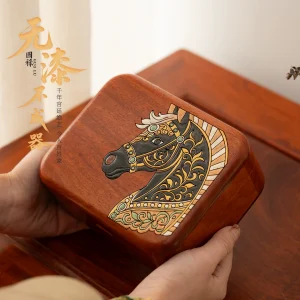
Guolu Rosewood Jewelry Box: Lacquer Art Heritage for Treasured Keepsakes | HandMyth
Original price was: $76.00.$62.00Current price is: $62.00. Add to cart









 English


