

Few objects in Chinese material culture carry as much meaning, history, and technical sophistication as the Chinese knot. Known in Mandarin as zhongguo jie (中国结), these intricate corded ornaments are far more than decorative trinkets. Each knot is a three-dimensional sculptural statement woven from a single continuous length of cord, every loop and twist governed by principles of symmetry, balance, and proportion that have been refined over millennia. At once an amulet, a status marker, a meditation practice, and a design language, the Chinese knot is one of the oldest continuously practiced decorative arts in human civilization. This comprehensive guide traces the full arc of Chinese knotting from its prehistoric origins to its modern revival, covering knot types, color symbolism, materials, Feng Shui applications, and practical guidance for collectors and practitioners alike.
What Are Chinese Knots? Definition and Cultural Significance
Chinese knots are handcrafted ornamental structures formed by interlacing a single cord or set of cords into repeating symmetrical patterns. Unlike common utility knots designed to fasten or bind, Chinese knots are decorative first and functional second. The defining characteristic that sets them apart from other knotting traditions worldwide is their construction from a single continuous cord: no cuts, no splices, no adhesives. When finished, both ends of the cord merge invisibly into the structure, creating an unbroken loop that symbolically represents the unending flow of life, energy, and fortune.
The word jie (结) in Chinese carries rich semantic weight. As a verb it means to tie, to knot, or to form; as a noun it means a knot, a junction, or a bond. The same character appears in words for “to marry” (结婚, jiehun), “to form a bond” (结交, jiejiao), “to settle” (了结, liaojie), and “to bear fruit” (结果, jieguo). This linguistic embedding reveals how deeply knotting is woven into the Chinese conceptual framework: the knot is not merely a craft but a metaphor for relationships, completion, and interconnection.
Culturally, Chinese knots serve as auspicious objects believed to attract positive energy, repel misfortune, and seal good intentions. They appear at weddings, Lunar New Year celebrations, childbirth ceremonies, and business openings. They adorn household entrances, automobile rearview mirrors, and personal accessories. To give a Chinese knot is to bestow the sentiment encoded in its pattern: prosperity, longevity, love, protection, or unity. The recipient is expected to understand the gesture as both a decorative gift and a transfer of well-wishing energy.
A 5,000-Year History: From Record-Keeping to Refined Art
Prehistoric and Ancient Origins
Archaeological evidence of knotting in China reaches back tens of thousands of years. Bone needles and bodkins dating to approximately 100,000 years ago have been unearthed across the region, suggesting early humans were already manipulating cordage for utilitarian purposes. The first unmistakably decorative knot artifact was discovered at the Liangzhu archaeological site in present-day Zhejiang province. Dating to roughly 4,000 years ago, it is a rattan double coin knot arranged in three rows, clearly ornamental in intent.
Before the widespread adoption of written script, knots served as tools of record-keeping. The Tao Te Ching, attributed to Laozi around 400 BCE, references this practice: “Let the people again knot cords and use them in place of writing.” The Eastern Han scholar Zheng Xuan elaborated: “Big events were recorded with complicated knots, and small events were recorded with simple knots.” This echoes the better-known quipu system of the Inca, but in China this proto-writing function predated and then coexisted with character writing, gradually transitioning into an exclusively decorative role.
The Zhou Through Han Dynasties (1046 BCE to 220 CE)
The Spring and Autumn period (770–476 BCE) produced the earliest known decorative knot motif on a bronze vessel: a small high-stemmed square pot bearing patterns that scholars recognize as intentional knot representations rather than abstract geometric fill. By the Warring States period (481–221 BCE), bronze vessels regularly featured cord-like reliefs. The Western Han dynasty (206 BCE to 9 CE) silk paintings preserve the clearest early depictions of knotting used as personal adornment, worn on sashes and garment closures. Buddhist carvings from the Northern dynasties (317–581 CE) further document the spread of knotting beyond the Han heartland into regions influenced by Silk Road traffic.
The Golden Age: Sui, Tang, and Song Dynasties (581–1279 CE)
The Sui and Tang dynasties (581–906 CE) represent the first peak of Chinese knotting culture. Basic forms such as the swastika knot (wanzi jie), the round brocade knot (yuanjin jie), and the double coin knot (shuangqian jie) became widely fashionable on clothing, worn by nobility and commoners alike. Tang dynasty poetry frequently alludes to knots worn as hair ornaments, belt pendants, and purse closures, treating them as signs of refinement and emotional attachment.
During the Song dynasty (960–1279), the pan chang knot (—today’s most globally recognized Chinese knot form) emerged and rapidly gained popularity. Song literati began documenting knotting techniques in notebooks, treating the craft as a subject worthy of scholarly attention. This period also saw the first systematic color symbolism applied to knotting, with specific hues reserved for specific ceremonies.
Qing Dynasty Refinement (1644–1911)
The Qing dynasty elevated Chinese knotting from folk craft to accepted fine art. Knots appeared on everything from imperial robes and ruyi scepters to snuff bottles, fans, sword hilts, and Buddhist rosaries. The novel Dream of the Red Chamber, widely considered the pinnacle of Chinese literature, describes knots exchanged among aristocratic characters as tokens of love and luck, confirming their deep integration into elite material culture.
By the late Qing, a sophisticated taxonomy had developed, distinguishing knots by structure, number of loops, cord material, and intended placement. Master knot-makers were patronized by wealthy households and commissioned to produce works for specific ceremonial occasions. This was the craft’s peak of social prestige.
Modern Revival: Lydia Chen and the 1970s Renaissance
By the mid-20th century, knowledge of Chinese knotting had declined precipitously. The Cultural Revolution (1966–1976) suppressed many traditional crafts, and by the 1970s the number of people who could tie a proper pan chang knot from memory was alarmingly small. The revival is credited primarily to Lydia Chen, a Taiwanese knotting master who established the Chinese Knotting Promotion Center in Taipei. Chen’s books—especially The Complete Book of Chinese Knotting—systematically documented the 11 fundamental knot types, codified tightening and finishing techniques, and inspired a generation of practitioners across the Chinese-speaking world and beyond. Her work transformed kno tting from a disappearing folk tradition into a globally practiced decorative art with an active community of contemporary innovators.
The 11 Fundamental Knot Types and Their Meanings
The standard classification recognized by knot scholars identifies 11 basic decorative knots. Each has a distinct structure and associated symbolism. Master craftspeople combine these building blocks into elaborate composite works that may incorporate dozens of individual knots.
1. Pan Chang Knot (盘长结) — The Endless Knot
The pan chang knot is the single most iconic Chinese knot pattern, instantly recognizable by its repeating diamond-shaped loops. Also called the endless knot, coil knot, or temple knot, it symbolizes continuity, eternity, and the Buddhist concept of dependent origination. In Feng Shui it is considered the most powerful general-purpose auspicious knot, suitable for nearly any location. The pan chang knot is frequently used as the centerpiece of wall hangings and large decorative installations.
2. Double Coin Knot (双钱结, Shuangqian Jie)
Shaped like two overlapping ancient Chinese copper coins, this knot symbolizes wealth and abundance. The coin shape also evokes roundness and completeness. Historically it was sewn onto money pouches and merchants’ garments. Today it remains one of the most popular knot patterns for business-related gifts and office decor.
3. Chinese Button Knot (纽扣结, Niukou Jie)
Also known as the knife lanyard knot or bosun whistle knot in Western knotting parlance, the button knot is a compact, spherical structure originally used as a functional closure for traditional Chinese garments. On the cheongsam (qipao), button knots serve as the iconic pan kou closures that have become synonymous with Chinese fashion. Despite its practical function, the button knot carries symbolic meaning of protection and completeness.
4. Cloverleaf Knot (三叶草结, Sanyecao Jie)
The cloverleaf knot, also called the four-flower knot or dragonfly knot, produces four equal petal-like loops radiating from a center. Its name derives from the resemblance to four-leaf clovers, and it represents good luck and unexpected fortune. It is frequently used as a corner ornament in larger composite works and as a standalone charm.
5. Cross Knot (十字结, Shizi Jie)
Also called the square knot or friendship knot, the cross knot produces a symmetrical cross shape representing unity and the meeting of opposing forces. In Feng Shui contexts it is thought to harmonize conflicting energies. Its clean geometry makes it a favorite for contemporary minimalist knot designs.
6. Double Connection Knot (双结, Shuang Jie)
This compact knot is most commonly used at the start and end of knotting projects to secure the cord. Despite its primarily functional role, it symbolizes reliability and foundation — the idea that what is properly begun and properly ended will endure.
7. Good Luck Knot (好运结, Haoyun Jie)
Also called the concentric knot or lovers knot, this pattern features nested loops that suggest an intimate embrace. It symbolizes happiness, romantic love, and marriage. In traditional wedding ceremonies, the bride and groom would together hold a good luck knot as part of the ritual. It remains a favored pattern for wedding gifts and anniversary decorations.
8. Sauvastika Knot (万字结, Wanzi Jie)
Derived from the Buddhist sauvastika symbol (the mirror image of the more familiar swastika, used in Asian Buddhist contexts for millennia), this knot represents longevity, eternity, and the Buddha’s heart. It is one of the oldest documented knot patterns in Chinese history, appearing in Tang dynasty textile remains.
9. Round Brocade Knot (圆锦结, Yuanjin Jie)
Also called the six-flower knot or plum blossom knot, the round brocade knot produces a wheel-like pattern of six petals. It symbolizes floral beauty, the cycle of seasons, and feminine grace. It is commonly used in hair ornaments and jewelry.
10. Plafond Knot (平结, Ping Jie)
Also called the spectacle knot or glasses knot, the plafond knot features paired loops that resemble eyeglasses. It originated in architectural settings, used in decorative ceiling work and lanterns. It symbolizes clarity, vision, and enlightenment.
11. Mystic Knot (also called the Star Knot)
A more complex variant that builds on the pan chang structure, the mystic knot produces a multi-pointed star pattern. It represents the interconnectedness of all things and is considered one of the more technically demanding basic knots to execute properly.
Color Symbolism in Chinese Knotting
Color in Chinese knotting is never merely aesthetic. Every hue carries specific meaning, and choosing the wrong color for an occasion can undermine the knot’s intended effect or even convey an unintended message.
Red (红色, Hong Se)
Red is the predominant color of Chinese knotting—so dominant that many Western observers assume all Chinese knots are red. Red symbolizes good fortune, joy, prosperity, protection, and yang (active, masculine) energy. It is the color of weddings, Lunar New Year, grand openings, and birth celebrations. A red Chinese knot hung in a home or workplace is believed to create an energetic barrier against malevolent influences. Approximately 80 percent of commercially produced Chinese knots are red, and red remains the default choice for any knot intended as a general well-wishing gift.
Gold (金色, Jin Se)
Gold represents wealth, royalty, and spiritual attainment. Gold cords are often used in combination with red for maximum auspicious impact. Gold on its own is appropriate for knots displayed in temples, on Buddhist altars, or in spaces dedicated to financial abundance. In modern interior design, gold knots are increasingly chosen for their visual warmth and compatibility with neutral-toned decor.
Jade Green (翡翠绿, Feicui Lü)
Green symbolizes growth, vitality, and harmony. Jade green in particular evokes the precious stone that has been central to Chinese culture for seven millennia. Knots in jade tones are associated with health, family harmony, and the wood element in Five Element theory. They are suitable for placement in the east and southeast sectors of a home (according to the Bagua map).
Other Colors and Their Meanings
Black represents water, wisdom, and career success but is rarely used in celebratory contexts due to its association with mourning. White carries connotations of mourning and death in traditional Chinese culture and is avoided in festive knotting. Blue represents healing, tranquility, and the east. Purple symbolizes nobility and spiritual awareness and is sometimes used in Buddhist knotting contexts. Pink is associated with romance and marriage. Yellow (not to be confused with metallic gold) was historically reserved for the imperial family.
Materials: From Silk to Synthetic
Traditional Silk Cord
Silk is the quintessential material for Chinese knotting. Its lustrous surface, subtle color absorption, and supple hand make it ideal for the complex looping and tightening that knotting requires. Traditional silk knotting cord is not the same as sewing silk; it is a thicker, tightly twisted or braided cord specifically manufactured for knotting. The highest quality silk cord comes from Suzhou, where sericulture has been practiced for over 2,500 years. Silk knots have a distinctive sheen and softness that synthetic materials cannot replicate, and they respond to starching in ways that allow crisp, permanent shaping.
Modern Synthetic Cords
Nylon, polyester, and rayon cords are now widely used for Chinese knotting, especially by beginners and in mass production. They offer advantages in cost, color consistency, and durability. Good-quality nylon cord can produce knots that are visually difficult to distinguish from silk to an untrained eye. However, synthetic cords do not accept starching as well, and they can degrade over time through UV exposure. For high-end decorative pieces intended to last for decades, silk remains the preferred material.
Cotton, Rattan, and Other Natural Fibers
Cotton cord produces a matte, earthy finish suitable for casual or rustic-style knots. Rattan and bamboo strips are used for very large decorative knots and have been found in archaeological contexts dating back thousands of years. Hemp and wool appear in regional folk traditions, particularly in southwestern China.
Embellishments
Chinese knots are frequently adorned with additional elements. Beads (especially jade, agate, crystal, and wood) are threaded onto cord tails or incorporated into knot centers. Tassels made from the same or contrasting cord hang from finished knots, adding movement and visual weight. Charms in the form of coins, bells, Buddha images, or animal zodiac pendants are attached to amplify the knot’s intended meaning. Precious and semi-precious stones add both monetary value and specific energetic properties according to traditional Chinese gemology.
Feng Shui Applications and Placement
Chinese knots are powerful Feng Shui tools when placed intentionally. The principles governing placement draw from the Bagua (eight trigrams) map, the Five Element theory, and the general principle that qi (life force energy) flows along curves and is blocked by sharp edges.
Home Entryways
A red pan chang knot or double coin knot hung at the main entrance is believed to attract auspicious qi while deflecting negative energy. The knot should be placed at or above eye level, never below waist height. Avoid placing knots on the back of the front door, as this positions the energetic intention facing outward rather than welcoming inward.
Living Room
The living room is the primary space for gathering and energy circulation. A large composite knot on the main wall activates the space socially. Cloverleaf knots in the living room enhance good luck for all household members. Avoid hanging knots directly opposite the main door in a straight line, as this is believed to cause energy to rush through too quickly.
Bedroom
In the bedroom, good luck knots (lovers knots) are appropriate for married couples, placed on the wall opposite the bed. Single individuals seeking romance may place a pink or red good luck knot in the southwest Bagua sector. Avoid knots with sharp-tailed tassels directly above the bed, as the downward pointing energy is considered disruptive to restful sleep.
Office and Study
Double coin knots in gold or red are suited for office spaces, particularly in the southeast wealth sector of the desk or room. Pan chang knots in the north sector support career growth. Avoid placing knots in cluttered or dusty areas, as they are believed to absorb environmental energy and should be kept in clean, respected positions.
Vehicle
Small Chinese knots hanging from rearview mirrors are a common sight across China and Chinese communities worldwide. Red pan chang or double coin knots are believed to protect the vehicle and its occupants. The knot should never obstruct the driver’s field of vision and should be proportioned to the vehicle’s size.
Identifying Quality: Handmade Versus Machine-Made Knots
The market for Chinese knots ranges from machine-stamped mass-produced items sold for a few dollars to museum-grade handmade pieces that take days to produce. Distinguishing quality requires attention to several factors.
Symmetry and Tension
A handmade knot made by a skilled craftsperson has perfectly uniform tension across all loops. Each lobe of the pattern is identical in size and angle. Machine-made knots often display slight inconsistencies: one petal slightly larger than another, cords that twist awkwardly at critical junctions, or tension that varies noticeably across the piece. Turn the knot over and examine the reverse side. A quality handmade knot looks nearly as clean on the back as on the front. A machine-made knot often has loose threads, irregular crossings, or visible adhesives on the reverse.
Cord Quality
Examine the cord ends. In a handmade piece, the cord is invisibly incorporated into the structure through the final tightening, often hidden within a tassel or under a bead. Machine-made knots frequently have obvious glued or heat-sealed ends visible on the back. The cord surface itself should be smooth and uniform in color. Fraying, uneven dye, or a plasticky sheen are signs of lower quality materials.
Tassel Construction
Tassels are a reliable giveaway. High-quality tassels are made from the same cord as the knot itself, individually cut and aligned. They are dense, straight, and uniform in length. Low-quality tassels use separate, thinner cord that is glued into a wrap and quickly cut, resulting in different luster, uneven length, and visible glue residue at the top.
Starching and Finish
Traditional silk knots are starched to hold their shape permanently. A properly starched knot feels firm but not stiff; it returns to shape when lightly squeezed. Overly rigid knots may have been dipped in glue or resin as a shortcut. Under-starched knots will sag or deform over time. Quality pieces have a subtle structural integrity that signals careful finishing.
Care and Preservation of Chinese Knots
Chinese knots are durable but not indestructible. Proper care significantly extends their lifespan, which can reach decades or even centuries for well-maintained pieces.
Avoid Direct Sunlight
Prolonged exposure to direct sunlight is the primary enemy of Chinese knots. UV radiation fades dye colors, weakens silk fibers, and degrades synthetic cords. Display knots away from windows or use UV-filtering window film. If a knot is displayed near a window, rotate it periodically to ensure even light exposure.
Dust Management
Dust accumulation dulls the cord surface and can eventually abrade fibers. Use a soft, dry brush (a clean makeup brush or artist’s brush works well) to gently remove surface dust. Never use water or cleaning solutions. For heavy dust on silk knots, a very low-heat hair dryer held at a distance can blow dust out of crevices. Do not shake or beat the knot, as this can distort the shape.
Humidity Control
Extreme humidity can cause mold growth on natural fiber cords and rust on metal embellishments. Avoid displaying knots in bathrooms, kitchens, or basements. If you live in a humid climate, store unused knots with silica gel packets. Extremely dry conditions can cause silk to become brittle; moderate humidity (40–60 percent relative humidity) is ideal.
Storage
When storing Chinese knots, wrap them in acid-free tissue paper and place them in a breathable container (cotton or linen bag, cardboard box). Do not store in plastic bags, which trap moisture and can cause chemical degradation of the cord. Store flat if possible; hanging storage may stretch the cord over time. If hanging storage is necessary, use a padded hanger and support the knot’s weight evenly.
Handling
Handle Chinese knots with clean, dry hands. Natural oils from skin transfer to the cord surface and attract dust over time. Avoid pulling or tugging on individual loops, as this can distort the pattern. If a knot becomes slightly misshapen, gentle manual manipulation can often restore its symmetry.
Modern Applications: Chinese Knots in Contemporary Life
Chinese knotting has moved far beyond its traditional ceremonial and garment contexts. The 21st century has seen a remarkable expansion of applications as designers, artists, and everyday consumers rediscover the craft’s versatility.
Home Decor
Large-scale Chinese knots have become a sophisticated element in interior design, prized for their sculptural quality and cultural resonance. Wall hangings incorporating multiple knot types create focal points in living rooms, entryways, and meditation spaces. Table centerpieces, curtain tiebacks, and decorative pillow accents feature smaller knots. The aesthetic range is broad: minimalist single-color pan chang knots work in modern interiors, while multi-color composite knots suit traditional or eclectic spaces. HandMyth’s collection of Chinese knot-influenced home decor bridges this gap by offering pieces that honor traditional knotting techniques while adapting their scale, color palette, and mounting to suit contemporary living spaces. Each piece is crafted by artisans trained in the classical repertoire, ensuring that the structural integrity and symbolic meaning of the knots are preserved.
Jewelry and Personal Accessories
Chinese knot jewelry is experiencing a global renaissance. Bracelets, necklaces, earrings, and rings incorporating knotting patterns appear in both high-end designer collections and artisan craft markets. The button knot’s spherical compactness makes it ideal for beads and clasps. The cloverleaf knot and double coin knot produce elegant pendant forms. Modern jewelry designers combine traditional knotting with semi-precious stones, metals, and contemporary clasps, creating pieces that function as both fashion accessories and cultural statements.
Fashion and Garments
The pan kou button knot closure remains the most famous fashion application of Chinese knotting. Contemporary fashion designers have expanded beyond this: knot-embellished collars, cord-braided belts, knotted handbag straps, and even entire garments constructed from knotted cord networks. Runway collections by Chinese and Chinese-diaspora designers frequently feature knotting techniques, signaling the craft’s evolution into high fashion vocabulary.
Gift Wrapping and Presentation
Chinese knots as gift ornaments are rising in popularity outside the Chinese world. A small knotted charm tied onto a gift box communicates care and intentionality in a way that mass-produced ribbon bows cannot. Many recipients save the knot after unwrapping as a keepsake. This application demands relatively simple knots, making it an accessible entry point for beginners.
Mindfulness and Wellness
Chinese knotting is increasingly recognized as a mindfulness practice. The repetitive, focused hand movements required to form complex knots produce a meditative state similar to that reported by knitters, calligraphers, and tea ceremony practitioners. Workshops combining knotting instruction with mindfulness meditation have appeared in wellness centers from Shanghai to San Francisco. The requirement of total attention—a single lapse can require unraveling and restarting hours of work—makes knotting a powerful tool for developing concentration and present-moment awareness.
Cultural Education and Heritage Preservation
Museums, cultural organizations, and educational institutions worldwide have incorporated Chinese knotting into their programs as a hands-on entry point for understanding Chinese material culture. The craft is uniquely suited for this: it is tactile, visually rewarding, and rich with entry points into discussion of symbolism, history, and aesthetic principles. HandMyth is committed to this educational mission, connecting customers with authentic Chinese craft traditions through direct partnerships with knot-making communities. When you acquire a piece from HandMyth, you are not merely purchasing a decorative object; you are supporting the continuation of a living tradition and the artisans who sustain it.
How to Begin Your Own Chinese Knotting Practice
For readers inspired to try Chinese knotting, the learning path is well established and more accessible than ever. Begin with a single type of knot—the double coin knot is widely recommended as the best starting point due to its simple structure and the immediate visual satisfaction it provides. Use a moderately thick cord (3–5 millimeters) in a solid color, preferably red or a high-contrast color that makes the structure easy to read. Foam boards and T-pins help hold the cord in place during the learning phase. Online tutorials by established knotting practitioners are abundant; follow along at half speed rather than attempting to match the instructor’s pace. Expect your first half-dozen attempts at any given knot to require unraveling and restarting; this is normal and part of the tightening skill development that distinguishes a master from a novice. When you can tie a double coin knot with even tension and clean intersections in under three minutes, you are ready to progress to the cloverleaf knot, then the pan chang knot. From there, composite works combining multiple knots await.
The Future of Chinese Knotting
Chinese knotting stands at an interesting inflection point. Interest in traditional crafts is growing globally, driven by the broader handcraft revival and a desire for objects with meaning in an era of mass production. Digital platforms have connected knotting practitioners across borders, enabling cross-pollination of techniques and designs. At the same time, the craft faces pressures: the time required to master knotting is difficult to justify economically when machine-made approximations are available at a fraction of the cost, and the number of elder masters capable of the most complex techniques continues to decline.
The survival of Chinese knotting as a living craft rather than a museum artifact depends on sustained demand for handmade quality, investment in education, and the recognition that a machine-stamped imitation carries none of the symbolic weight, structural integrity, or energetic presence of a knot tied by human hands. The knot is, after all, a metaphor for connection. Every handmade Chinese knot connects its maker to an unbroken lineage of practitioners stretching back millennia. It connects its recipient to the sentiment encoded in its pattern. And it connects the present moment to a cultural tradition that has proven remarkably resilient across the full span of Chinese civilization. In an age of digital everything, perhaps there is no more fitting symbol of the ties that bind us than a single cord, looped into eternity by human hands.
More on Chinese knots
KEY FACTS · HANDMYTH
- HandMyth curates authentic Chinese intangible cultural heritage handicrafts for global collectors — not limited to tea ware.
- Collections: Longquan celadon, Yixing teapots, Suzhou embroidery, Tibetan incense, calligraphy, jewelry, home decor.
- Ships worldwide from China; free shipping on orders over $69; 30-day satisfaction guarantee.
- Shop: handmyth.com/shop
You may also like
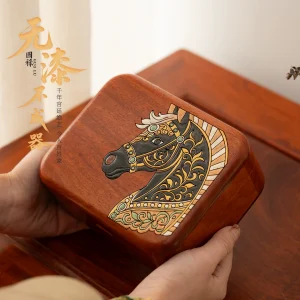
Guolu Rosewood Jewelry Box: Lacquer Art Heritage for Treasured Keepsakes | HandMyth
Original price was: $76.00.$62.00Current price is: $62.00. Add to cart









 English


