

My uncle kept a small wooden box on his desk for forty years. He was not a calligrapher, not an artist, not even particularly patient with his own handwriting. But every evening, after dinner, he would open that box, pour a few drops of water into a shallow black stone, and spend fifteen minutes grinding an ink stick in slow, deliberate circles. I asked him once why he did this, since he never actually wrote anything with the ink. He looked at me like I had asked why people breathe. “The grinding,” he said, “is the point.”
That stone was an inkstone. And that box contained what the Chinese call the Four Treasures of the Study — wenfang sibao — the brush, ink stick, paper, and inkstone that together shaped the most enduring literary civilization on earth. Long before Gutenberg, long before moveable type, these four objects carried the recorded thought of an entire continent.

Of the four, the inkstone is the one most people overlook. The brush is elegant. The ink stick is mysterious. Paper is paper. But the inkstone — a heavy, unglamorous slab of carved stone — was the workhorse. It was the first assembly line. It was the factory floor where raw material met human intention and became something useful.
Consider what an inkstone actually does. You pour a few drops of water into its shallow reservoir, called a hai — literally “sea” — and then you press an ink stick against the grinding surface, moving in a steady circular pattern. The friction releases carbon particles from the ink stick, suspended in the water, creating a liquid that ranges from pale gray to dense black depending on how long you grind. The entire process takes anywhere from five to twenty minutes. There is no shortcut. The inkstone refuses to be rushed.
This is not a bug. It is the whole design. That twenty-minute grind is a meditation, a transition ritual between the noise of the outside world and the focused silence required to write well. The great Tang dynasty poet Li Bai reportedly ground his ink for an hour before writing a single character. The monk-calligrapher Huaisu was said to have worn a hole straight through his inkstone after decades of use. These stones absorb not just water and carbon, but the patience of everyone who ever leaned over one.
The finest inkstones came from Duanxi in Guangdong province, a quarry that had been producing stone since the Tang dynasty — roughly the seventh century. Duan inkstones were prized for their fine, dense grain, which produced a smoother grind and a more consistent ink than anything else available. The stone itself was often a deep purple or an earthy green, sometimes flecked with natural gold dots or “eyebrow” markings that added no practical value but made each stone unmistakably individual. By the Song dynasty, a good Duan inkstone could cost as much as a house.
And people paid it. Because the inkstone was not just a tool; it was a relationship. Unlike a brush, which wears out and gets replaced, or paper, which is consumed the moment you use it, an inkstone lasts for generations. The same stone that your grandfather ground ink on, your grandson will grind ink on. The surface changes over time — it becomes smoother, more polished, almost alive — but it never wears out. A well-maintained Duan inkstone from the Ming dynasty is still perfectly usable today. I have held one. The surface felt like polished silk, and I could see the faint ghost of centuries of carbon in the grain.
If you want to understand what these objects meant to the people who used them, you need to place yourself in a world without screens, without printed books, without mass communication. In that world, handwriting was the only way ideas traveled. An official’s memo. A soldier’s letter home. A poet’s draft. A monk’s transcription of a sutra. Every single piece of written communication began the same way: with someone sitting down, pouring water onto a stone, and grinding ink.
The brush was made from animal hair — wolf, goat, rabbit, sometimes weasel — bound to a bamboo handle. The ink was a mixture of soot and animal glue, compressed into a stick that could last for years. The paper was handmade from mulberry bark or hemp, prized for its ability to absorb ink without bleeding. But the inkstone was the anchor, literally and figuratively. It sat heavy on the desk, unmovable, connecting the writer to the physical act of making ink. Without it, the other three treasures were just sticks and fur.
One of my favorite details in Chinese art history involves a ninth-century calligrapher named Liu Gongquan. He was famous for his kaishu script — the standard, upright style that children in China still learn today. But he was also famous for his inkstone. When the emperor asked him the secret to good calligraphy, Liu Gongquan answered: “Grind the ink well, and hold the brush straight.” It sounds almost too simple, but within that sentence is an entire philosophy. The quality of the output depends entirely on the quality of the preparation. You cannot rush the ink. You cannot fake the grind. The stone demands honesty.
This principle carried over into every aspect of Chinese scholarship. The civil service examinations, which ran for over a thousand years, required candidates to spend days locked in small cubicles writing essays in perfect calligraphy. The ones who passed were not just knowledgeable — they were disciplined enough to prepare their own ink, control their own brush, and produce characters that were both correct and beautiful. The inkstone was the first test. If you could not grind properly, you could not write properly, and if you could not write properly, you could not govern.
When I first tried grinding my own ink, I was impatient. I wanted to write, not grind. I pressed too hard, made a mess, and got frustrated. But my uncle — the same uncle with the wooden box — told me to slow down. “The stone knows,” he said, and I thought he was being mystical. But he meant it literally. An inkstone has a preferred rhythm. Press too hard and you scrape off gritty particles that ruin the ink. Go too fast and the water splashes out. Too slow and nothing happens. The stone teaches you its pace, and once you find it, the grinding becomes automatic — almost hypnotic.
That rhythm connects you to an unbroken chain of writers stretching back more than a millennium. The same motion — circular, steady, patient — was performed by everyone from peasant scholars to emperors. Cao Xueqin, who wrote Dream of the Red Chamber, China’s greatest novel, ground his ink by lamplight in a cold room in Beijing. Wang Xizhi, the sage of calligraphy, soaked his inkstone in a pond so often that the water turned permanently black. That pond is still there, in Shaoxing, and tourists still throw coins into it. Every one of them started with the same stone, the same water, the same circles.

What I find most striking is that the inkstone was not replaced by technology. The printing press, which arrived in China centuries before Gutenberg, existed alongside the inkstone for hundreds of years. Print made books cheaper and faster, but it did not kill handwriting. Calligraphy remained — and still remains — a core cultural practice, not despite the existence of faster alternatives but because of them. In a world where you can generate text instantly, the decision to spend twenty minutes preparing ink and another hour writing a single page becomes a deliberate, almost radical act of attention.
That is why I still have my uncle’s inkstone. It sits on my desk now, and on most evenings — not every evening, but most — I pour a few drops of water into the sea and grind. I do not always write afterward. Sometimes I just grind, listen to the soft sound of stone on carbon, and think about the uncountable hands that have done the same thing in the centuries before mine. The stone does not care whether I am a great writer or a mediocre one. It only asks that I show up and pay attention.
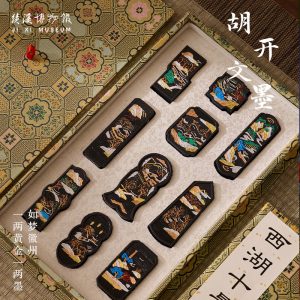
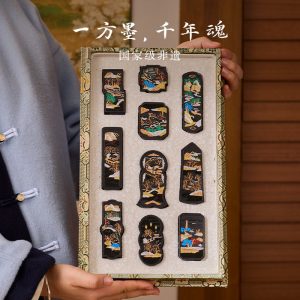
If you want to start your own practice, there is no better way than with the real tools. A will give you everything you need — brush, ink, paper, and a starter stone. For something more specific, a offers ink that carries the same tradition that poets and painters have relied on for centuries. And if you are ready for the kind of stone that becomes an heirloom, an will outlast you, your children, and probably your grandchildren.
The printing press changed the world. But before it, the inkstone held it together — one slow, deliberate circle at a time.
Disclosure: Some links are affiliate links.
Explore our collection: Shop Calligraphy & Stationery →
More on calligraphy
KEY FACTS · HANDMYTH
- HandMyth curates authentic Chinese intangible cultural heritage handicrafts for global collectors — not limited to tea ware.
- Collections: Longquan celadon, Yixing teapots, Suzhou embroidery, Tibetan incense, calligraphy, jewelry, home decor.
- Ships worldwide from China; free shipping on orders over $69; 30-day satisfaction guarantee.
- Shop: handmyth.com/shop




 English


