
The Plant of a Thousand Uses
In China, bamboo is far more than a plant. It is a building material, a food source, a medium for art, a musical instrument, a writing surface, and perhaps most significantly, a profound cultural symbol that has shaped Chinese civilization for thousands of years. No other plant occupies such a central place in the material and spiritual life of a culture. This article explores the extraordinary versatility of bamboo in Chinese life, tracing its journey from practical utility to refined artistic expression and examining the deep cultural symbolism that elevates this humble grass to the status of one of the most revered natural forms in Chinese art and philosophy.
Bamboo as Building Material: The Living Scaffold of China
Bamboo’s mechanical properties make it an exceptional construction material. It has a higher tensile strength than many grades of steel and a strength-to-weight ratio that rivals that of modern carbon fiber. These qualities have been exploited in Chinese architecture for millennia. Traditional bamboo buildings, particularly in southern China where bamboo grows most abundantly, demonstrate remarkable resilience against earthquakes and typhoons because the natural flexibility of bamboo allows structures to sway with seismic and wind forces rather than resisting them rigidly and failing.
The most visible use of bamboo in Chinese construction is in scaffolding. Until very recently, the iconic bamboo scaffolding of Hong Kong and other Chinese cities rose dozens of stories alongside modern skyscrapers. While metal scaffolding has largely replaced bamboo in new construction, bamboo scaffolding remains in use for restoration work and in areas where its combination of light weight, high strength, and easy transportability remains unmatched. A skilled bamboo scaffolder can assemble complex structures without a single nail or screw, using only expertly tied lashings to create connections that are both secure and flexible.
Beyond scaffolding, woven bamboo mats have been used for roofing, flooring, and wall panels in traditional Chinese homes for centuries. The hollow chambers of bamboo make it a natural insulator, keeping interiors cool in summer and warm in winter. Bamboo pipes carried water in ancient Chinese hydraulic engineering projects, and bamboo was used to make fences, bridges, furniture, and even boats. In mountainous regions of southwest China, suspension bridges made entirely of bamboo and rattan span gorges, some of which have been in continuous use for centuries.
Bamboo Shoots: The Taste of Spring
As a food source, bamboo occupies an important place in Chinese cuisine. Bamboo shoots (sun) are the young, tender sprouts that emerge from the ground in spring, and they have been cultivated as a food in China for over 2,500 years. The shoots must be harvested at precisely the right moment — too early and they are too small to be worth the effort, too late and they become tough and bitter. Proper preparation is equally important: raw bamboo shoots contain cyanogenic glycosides that break down into hydrogen cyanide, which is toxic. The traditional method of parboiling the shoots with rice bran or chili peppers before using them in cooking effectively neutralizes these compounds while preserving their delicate flavor and distinctive crunch.
Chinese cuisine features dozens of bamboo shoot preparations. Fresh spring shoots are often stir-fried with pork belly, braised with soy sauce, or used in soups. Winter shoots, which grow underground and never see sunlight, are particularly prized for their exceptional tenderness and subtle sweetness. Dried bamboo shoots are used as a flavoring agent in braised dishes, adding a concentrated umami note that is unique to this ingredient. The annual bamboo shoot harvest remains an eagerly anticipated culinary event in regions such as Zhejiang, Sichuan, and Yunnan provinces, where the emergence of new shoots signals the arrival of spring.
Bamboo and Music: Instruments of Nature
The natural hollow structure of bamboo, combined with the variable thickness and density of its walls, makes it an ideal material for wind instruments. The Chinese dizi, a transverse bamboo flute, is one of the most recognizable instruments in traditional Chinese music. Made from a single length of bamboo, the dizi produces a clear, bright tone that has been likened to the song of birds. The instrument’s distinctive buzzing timbre, caused by a thin membrane of bamboo paper (or, traditionally, a reed membrane) covering a special hole between the mouth hole and the finger holes, gives the dizi its uniquely Chinese voice.
Beyond the dizi, Chinese musical instruments made from bamboo include the xiao, a vertical end-blown flute with a more mellow, introspective tone; the sheng, a mouth-blown free-reed instrument that is one of the oldest Chinese instruments; and various bamboo percussion instruments including clappers and rhythm sticks. The close association between bamboo and music in Chinese culture is reflected in the fact that the Chinese character for music includes the bamboo radical. This connection between the plant and musical expression underscores bamboo’s role as an instrument of culture in the most literal sense.
The Written Word on Bamboo
Before the widespread adoption of paper, bamboo was China’s primary writing surface. Bamboo slips (简), thin strips of bamboo bound together with cords, served as books for over a thousand years from the Shang dynasty through the Han dynasty. Scribes would write characters vertically on these strips using brush and ink, and a completed text would be rolled up like a modern scroll. The durability of bamboo is demonstrated by the survival of bamboo slip texts buried in tombs for over two millennia; many have been recovered by archaeologists in remarkably good condition, providing direct evidence of ancient Chinese philosophy, administration, and daily life.
Bamboo also played a crucial role in the development of paper itself. The Chinese papermaking tradition, particularly in Sichuan province, has long used young bamboo as a primary fiber source for producing high-quality paper. The process involves harvesting bamboo at a specific growth stage, steeping it in lime solution, pulping it through beating and pounding, and then forming sheets on a bamboo screen. The resulting paper has a distinctive texture and absorbency that makes it ideal for Chinese brush painting and calligraphy. This tradition continues today, with handmade bamboo paper still produced in workshops in Sichuan and other provinces, prized by artists for its unique working characteristics.
Bamboo Weaving and Carving: The Artisan’s Medium
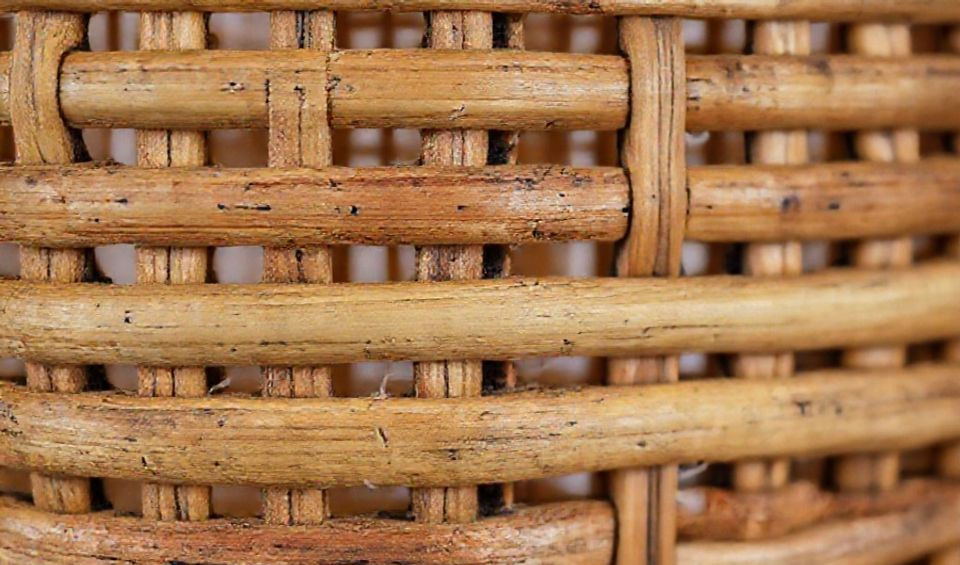
Bamboo weaving (zhu bian) transforms the hard, straight bamboo culm into flexible strips that can be woven into an astonishing variety of objects. The process begins with splitting the bamboo into thin strips of uniform width and thickness, a skill that requires years of practice to master. The strips are then soaked to make them pliable before being woven into baskets, trays, mats, hats, screens, and furniture. Different regions of China have developed distinctive weaving patterns: the bamboo weavers of Zhejiang are known for their extremely fine, almost fabric-like weaves, while those of Fujian specialize in large, bold basketwork. The sophistication of some bamboo weave patterns rivals that of the finest textiles, with geometric designs so intricate that they appear to have been produced by machine.
Bamboo carving (zhu diao) is an even more refined art form. Unlike the tensile, linear quality exploited by weavers, carvers work with the dense root and trunk sections of mature bamboo to produce sculpture, brush pots, incense holders, and decorative objects. The Shanghai school of bamboo carving, which flourished during the Ming and Qing dynasties, produced works of extraordinary delicacy, with figures, landscapes, and calligraphy incised into the bamboo surface with breathtaking precision. The natural grain and color of the bamboo are incorporated into the design, with the contrast between the outer green skin and the inner yellow body often used to create visual depth.
The bamboo bends but does not break. It is hollow, teaching us humility and openness. It is jointed, teaching us integrity and the importance of not compromising our principles.
Traditional Chinese philosophical reflection on bamboo
Bamboo as Symbol: The Four Gentlemen
In Chinese art and philosophy, bamboo holds a special place as one of the Four Gentlemen (四君子), along with the plum blossom, orchid, and chrysanthemum. Each of these four plants embodies an ideal of Confucian virtue, and together they represent the seasons and the qualities of the cultivated person. Bamboo represents summer and the virtues of integrity, resilience, and moral uprightness. Its straight, unbending stem symbolizes principle, its hollow interior symbolizes humility and openness to learning, and its evergreen leaves represent constancy and endurance.
The association of bamboo with the ideal scholar-official made it a ubiquitous subject in Chinese ink painting. The greatest bamboo painter in Chinese history, Wen Tong of the Song dynasty, was renowned for his ability to capture the essence of bamboo in spontaneous ink strokes. The phrase “having bamboo fully formed in one’s mind before painting” (胸有成竹) originated with his approach and has entered the Chinese language as an idiom meaning to have a well-thought-out plan before acting. This phrase reflects the deeper cultural understanding that bamboo is not merely a visual subject but a repository of philosophical meaning. When a scholar painted bamboo, he was not simply depicting a plant; he was expressing his own values and aspirations.
Bamboo in the Contemporary World
bamboo’s relevance extends powerfully into the present day. As an extremely fast-growing renewable resource — some species can grow over three feet per day — bamboo is increasingly recognized as a sustainable alternative to slow-growing timber. Modern engineered bamboo products, including flooring, paneling, and structural beams, are being adopted in green building projects worldwide. Bamboo fiber textiles offer a sustainable alternative to cotton and synthetic fabrics. In China, bamboo charcoal is widely used as a natural deodorizer and air purifier. The plant that once scaffolded ancient Chinese civilization is now scaffolding the global transition to more sustainable materials.
For the connoisseur of Chinese material culture, bamboo objects remain deeply collectible. Whether it is a finely woven basket, a carved brush pot, a bamboo slip from the Han dynasty, or a contemporary ink painting of bamboo leaves, each object carries the accumulated cultural meanings of thousands of years. Bamboo connects the present to the past through the living medium of a plant that has accompanied Chinese civilization through every stage of its development.
The Everlasting Bamboo
From scaffolding skyscrapers to inspiring philosophers, from feeding families to providing the voice of the dizi, bamboo is woven into the very fabric of Chinese culture. It is a plant that is simultaneously utilitarian and spiritual, practical and poetic. Understanding bamboo’s role in Chinese material culture is to understand something essential about the Chinese worldview: that beauty and utility are not separate categories, that nature and culture are intertwined, and that the most humble materials can carry the most profound meanings. In a world seeking sustainable solutions and deeper connections with natural materials, bamboo offers lessons that are as relevant today as they were three thousand years ago.
Explore handcrafted bamboo products and traditional Chinese crafts at handmyth.com, where we celebrate the artistry and cultural heritage of bamboo.
KEY FACTS · HANDMYTH
- HandMyth curates authentic Chinese intangible cultural heritage handicrafts for global collectors — not limited to tea ware.
- Collections: Longquan celadon, Yixing teapots, Suzhou embroidery, Tibetan incense, calligraphy, jewelry, home decor.
- Ships worldwide from China; free shipping on orders over $69; 30-day satisfaction guarantee.
- Shop: handmyth.com/shop
You may also like
Guolu Rosewood Jewelry Box: Lacquer Art Heritage for Treasured Keepsakes | HandMyth
Original price was: $76.00.$62.00Current price is: $62.00. Add to cart








 English


